How Often Can I Have Morpheus 8 Nuneaton?

Your guide to treatment frequency, results, and how it stacks up against other skin-rejuvenation options.
What is Morpheus 8 Nuneaton?
Morpheus 8 is a powerful skin-rejuvenation treatment that combines microneedling with radio-frequency (RF) energy. This dual-action penetrates deeply into the skin and underlying tissue, stimulating collagen and elastin production, tightening the texture, and improving overall tone and contour.
Because it works at a deeper level than many traditional treatments, it is an excellent choice for addressing concerns such as fine lines and wrinkles, loose or sagging skin, acne scars, and areas of laxity on the face and body.
How Many Morpheus 8 Nuneaton Sessions Do You Need & How Often?
To achieve the best results with Morpheus 8 and maintain long-lasting results, consider two phases: an initial series and maintenance.
Initial Series
- Many clinics suggest beginning with 3 to 4 sessions.
- During this period, the body is stimulated to rebuild collagen, improve skin tone and initiate tightening. Visible improvements may begin within weeks and continue to evolve over months.
Maintenance
- After your initial series, to maintain peak results, a maintenance session every 6 to 12 months is typical.
- Of course, factors such as age, skin condition, lifestyle (sun exposure, smoking, etc.) and treatment area will influence how often you personally need a touch-up.
Why this schedule?
- The 4-6 week gap allows your skin to respond to one session and recover before the next.
- Longer maintenance intervals (6-12 months) align with the duration for which new collagen structures remain active and effective.
- Over-treating or doing sessions too frequently may increase risk or reduce treatment effectiveness.
See our current promotions for Morpheus 8 Nuneaton
What to Expect: Morpheus 8 Nuneaton Results & Recovery
- The immediate recovery time is moderate. You may experience redness, swelling or mild crusting, which commonly resolves within 2-5 days.
- Complete improvements typically occur over 3-6 months as collagen production peaks.
- With proper care and maintenance, the visible benefits may last up to 12 months or longer, at which point a further session is ideal.
Who Is a Good Candidate For Morpheus 8 Nuneaton?
- People with moderate skin laxity, fine to moderate wrinkles, textural issues, acne or stretch marks on the face or body.
- Suitable for many skin types – especially beneficial when traditional treatments haven’t delivered sufficient depth of effect.
- However, not everyone is ideal: a deep surgical lift may still be required for very advanced laxity; a consultation should always precede any treatment.
Morpheus 8 Nuneaton vs Other Treatments: Which One Is Right for You?
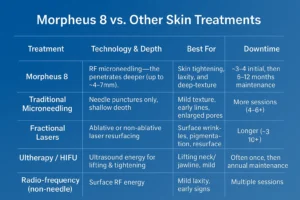
Key advantages of Morpheus 8 Nuneaton:
- Deeper penetration means more dramatic results in fewer sessions.
- Effective on both face & body, and across many skin types, including darker tones.
- Shorter downtime compared to ablative lasers.
Considerations:
- Costs tend to be higher than for simpler treatments.
- Recovery still requires some care and downtime, so plan accordingly.
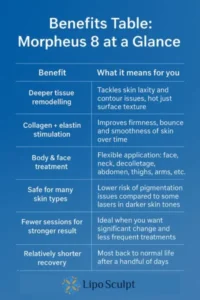
Benefits Table: Morpheus 8 Nuneaton at a Glance
Frequently Asked Questions (FAQ) About Morpheus 8 Nuneaton
Q1: How long should I wait between Morpheus 8 treatments?
Generally, you should wait 4-6 weeks between sessions during your initial course. For maintenance sessions, 6-12 months is common.
Q2: Is Morpheus 8 painful?
Some patients experience slight discomfort during treatment (topical numbing cream is used) and mild redness/swelling afterwards. The deeper penetration may make it feel more intense than basic microneedling. It is FDA-approved.
Q3: How soon will I see results?
You’ll see some improvement in the weeks following treatment, but full collagen-driven results usually take 3-6 months to develop.
Q4: How long do the results last?
With good skin care and lifestyle habits, results can last up to 12 months or longer before a maintenance session is recommended.
Q5: Can Morpheus 8 be combined with other treatments?
Yes — Morpheus 8 works well in combination with other protocols (e.g., fillers, skincare, laser) to address multiple layers of skin concerns.
Q6: Is everyone suitable for Morpheus 8?
Not automatically. Good candidates are those with realistic expectations, moderate skin concerns and good overall health. People with active skin infections, certain medical conditions, or who are pregnant may be advised against it. A consultation will provide clarity.
Q7: What should I do to prepare and aftercare?
- Avoid excessive sun exposure before you have treatment.
- On the day: gentle skin, no strong exfoliants or retinoids.
- After treatment: use SPF, avoid heavy makeup for 24 hrs, avoid active skincare for 48 hrs, follow your practitioner’s guidelines.
Final Thoughts About Morpheus 8 Nuneaton
If you’re seeking a versatile skin-rejuvenation treatment that offers more than just surface improvements—one that tightens, refines, remodels, and provides lasting benefits—Morpheus 8 is an excellent option.
With the right initial series of treatments and careful ongoing maintenance, it can be a valuable long-term ally in your journey towards better skin health.
Just ensure you work with a qualified clinician, follow the aftercare advice, and plan realistically for the number of sessions and downtime.
If you’d like to learn more about how Morpheus 8 Nuneaton could work for you — what areas to treat, how many sessions you might need and what results you can expect — book a consultation today at Lipo Sculpt. Let us tailor a plan that fits your skin, your goals and your lifestyle.